Why Minor Vehicle Damage Doesn’t Mean a Minor Injury
One of the most common assumptions after a car accident is this:
“If the vehicles weren’t badly damaged, the injuries must be minor.”
Insurance companies repeat this idea often while adjusters rely on it and defense lawyers frequently argue it.
But medically and scientifically, that assumption isn’t reliable.
In real-world accident cases, vehicle damage and injury severity do not always correlate.
Understanding why requires looking at how the human body actually responds to a collision.
Property Damage Measures the Car — Not the Body
When vehicles collide, repair estimates measure how much energy the vehicle structure absorbed.
They do not measure what happened to the occupants.
Modern vehicles are designed to:
- Absorb and redirect collision energy (a concept called “crush”)
- Protect the passenger compartment
- Reduce visible structural damage in lower-speed collisions
That engineering protects occupants in catastrophic crashes but it does not eliminate the forces experienced by the human body.
Even relatively small impacts can transmit significant acceleration forces to the neck and spine, and it’s these sudden, unexpected force exerted upon the spine which can cause hyper-extension or hyper-flexion of the spine.
The Biomechanics of Injury
In a rear-end or side-impact collision, the vehicle stops or changes direction rapidly while the human body inside the vehicle does not. Since the human is not mounted to the car, the car actually moves around the person. In a rear-end impact, the car will move forward relative to the passengers until the passenger’s body and head strike the seat at which point the passenger bounces forward. This happens so fast that most people think they were thrown forward and then backward when in reality they moved backwards relative to the car and then moved forward. Arthur Croft and Michael Freeman did many slow-motion studies confirming these.
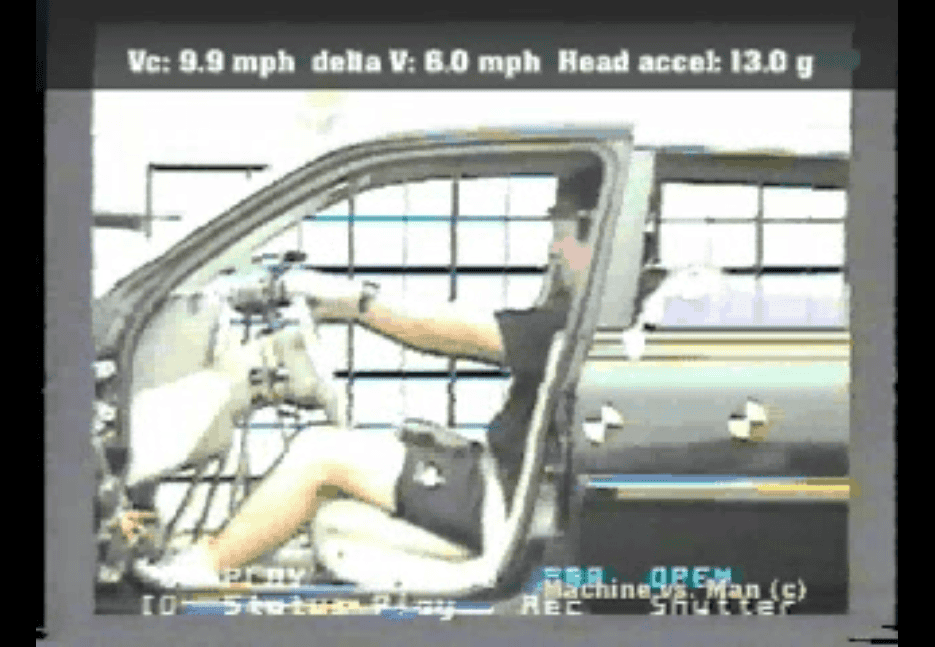
This mismatch creates:
- Rapid acceleration
- Rotational forces
- Shear forces along the spine
- Sudden stretching of ligaments and discs
These forces can produce injuries such as:
- Disc herniations
- Annular tears
- Nerve compression
- Ligament injuries
- Chronic muscle dysfunction
None of those injuries require major visible vehicle damage to occur.
Real-World Injury Patterns
Many serious injury cases follow a similar progression:
- A collision that appears relatively minor
- Initial soreness or stiffness
- Conservative treatment (physical therapy, chiropractic care)
- Persistent symptoms
- MRI imaging revealing structural injury
By the time objective findings appear, the claim may already have been labeled a “minor case” and that early classification can significantly influence how insurers approach the claim.
Why Juries Don’t Rely on Repair Bills
In courtrooms across the country, juries are routinely instructed that vehicle damage does not determine whether someone was injured.
Jurors understand a simple point:
A repair estimate describes damage to metal and plastic.
It does not describe damage to spinal discs, nerves, or ligaments.
Instead, juries focus on:
- Medical records
- Imaging studies
- Treating physician testimony
- The consistency of the injured person’s symptoms
- The impact of the injury on daily life
Those factors tell the real story.
The Risk of Dismissing an Injury Too Early
Many injured people initially assume their symptoms will resolve quickly, delay treatment, and try to push through the pain.
In some cases, that approach works.
But when symptoms persist, early assumptions about the seriousness of the injury can become misleading.
Proper evaluation — including appropriate medical imaging and follow-up care — is essential for determining the true nature of an injury.
The Bottom Line
Vehicle repair costs do not determine injury severity.
Some crashes that look dramatic produce minor injuries.
Other collisions that leave little visible damage can result in lasting medical problems.
What ultimately matters is the medical evidence and the impact of the injury on a person’s life.
If symptoms persist after an accident, a careful evaluation by medical professionals and experienced legal counsel can help ensure the situation is properly understood.