
The Hidden Insurance Danger of Riding in an Uber or Waymo on Texas
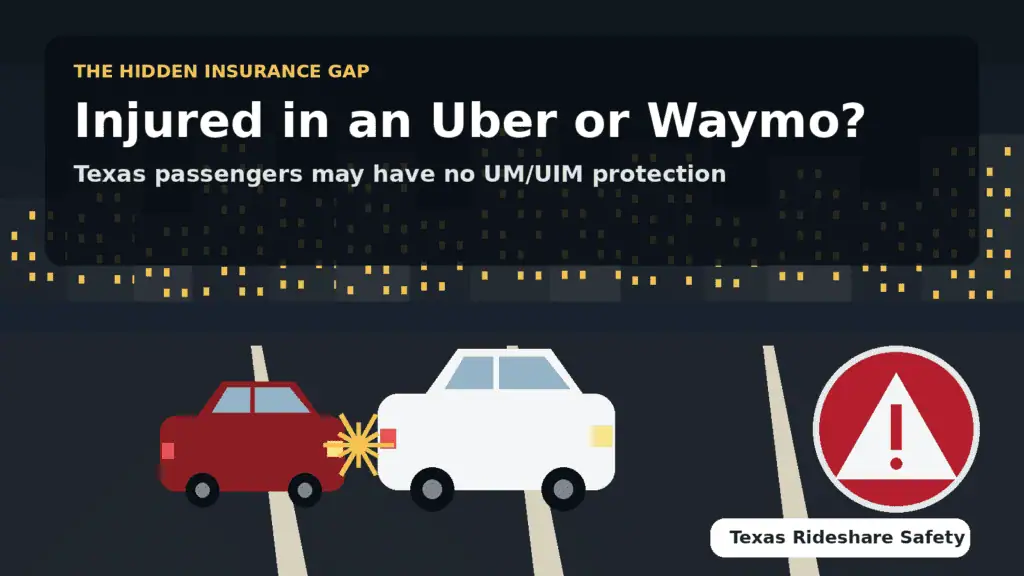
Imagine that you decide to take an Uber home one evening. As you are being driven to your destination, the Uber is suddenly struck from behind by a drunk driver who failed to brake.
You are seriously injured and taken by ambulance to the hospital. After emergency treatment, diagnostic testing and several days of care, you are released with instructions to see specialists and begin physical therapy. You cannot return to work immediately, your medical bills are accumulating and your doctors are not yet sure whether you will fully recover.
You make a claim with the drunk driver’s insurance company, expecting it to pay for the harm its insured caused. You then learn that the driver has no insurance at all.
You turn to Uber, expecting that a company of its size must have insurance to protect passengers. You have probably heard that Uber carries a $1 million insurance policy. But then you receive another unpleasant surprise: Uber’s large liability policy may not cover your injuries because the Uber driver did not cause the collision.
The drunk driver caused it.
If no uninsured motorist coverage applies, you may be left with enormous medical expenses, months of lost income and a serious injury—with no financially responsible insurance company required to compensate you fully.
A passenger riding in a Waymo vehicle can face the same problem. Waymo may carry limited medical payments coverage, often called MedPay, but limited MedPay is not the same as uninsured or underinsured motorist coverage. It may pay only a relatively small amount of medical expenses while providing nothing for lost wages, pain, disability or the long-term consequences of an injury.
This is one of the least understood dangers of relying on Uber, Waymo or similar transportation services in Texas. Unfortunately, I’ve had multiple potential clients find out this information only after they’ve been seriously injured.
A $1 Million Policy Does Not Cover Every Accident
Many passengers assume that Uber’s widely advertised commercial insurance coverage protects them whenever they are injured during a ride. That is not necessarily true.
Insurance coverage depends on who caused the collision and what type of policy applies.
Uber’s commercial policy primarily provides liability coverage. Liability insurance generally pays when the covered driver is legally responsible for causing an accident.
For example, if an Uber driver runs a red light, follows another vehicle too closely or makes an unsafe turn and injures a passenger, Uber’s liability coverage may apply because the Uber driver caused the crash.
The situation is different when the Uber driver did nothing wrong.
Suppose an Uber is stopped at a traffic light when another driver crashes into it from behind. Or imagine that another driver crosses the center line and strikes a Waymo vehicle head-on. In both situations, the outside driver—not the Uber driver or Waymo vehicle—may be legally responsible.
The passenger’s claim would ordinarily begin with the negligent driver’s liability insurance.
But what happens if that driver has no insurance?
What if the driver has only the minimum amount of coverage required by Texas law?
What if the driver flees the scene and is never identified?
Those are the situations in which uninsured and underinsured motorist coverage becomes essential.
What Is Uninsured Motorist Coverage?
Uninsured motorist coverage, commonly called UM coverage, protects an insured person when the driver who caused the accident has no applicable liability insurance.
An at-fault driver may be considered uninsured when:
- The driver never purchased automobile insurance.
- The policy expired or was canceled.
- The insurer denies coverage because the driver was excluded from the policy.
- The vehicle was stolen or being used without permission.
- The driver leaves the scene and cannot be identified.
- Another policy problem leaves no liability coverage available.
Without UM coverage, an injured passenger may be forced to pursue the uninsured driver personally.
That sounds like a solution in theory, but it is often worthless in practice. Many people who drive without insurance have few assets and limited income. An injured passenger may obtain a judgment against the driver but still be unable to collect meaningful compensation.
A court judgment does not pay hospital bills by itself. It does not replace lost wages, fund future medical treatment or compensate someone for permanent physical limitations.
UM coverage creates an insurance source from which the injured person may seek compensation when the negligent driver cannot provide it.
Depending on the policy and circumstances, UM bodily injury coverage may compensate an injured person for:
- Medical expenses.
- Future medical care.
- Lost wages.
- Reduced earning capacity.
- Physical pain.
- Mental anguish.
- Physical impairment.
- Disfigurement.
- Other legally recoverable damages.
This is far broader than coverage that merely pays a limited amount of medical bills.
What Is Underinsured Motorist Coverage?
Underinsured motorist coverage, usually called UIM coverage, applies when the at-fault driver has insurance but does not carry enough coverage to pay for the injuries caused.
Texas permits drivers to carry bodily injury liability limits as low as $30,000 for one injured person and $60,000 total for everyone injured in one accident.
Those amounts may sound substantial until someone is seriously hurt.
An ambulance ride, emergency-room treatment, CT scans, MRIs, specialist appointments and physical therapy can quickly consume much of a $30,000 policy. If the injured passenger requires surgery, hospitalization or long-term rehabilitation, the available insurance may cover only a small percentage of the total loss.
The problem becomes even worse when several people are injured.
Assume that an underinsured driver crashes into a Waymo vehicle carrying three passengers. The occupants of the other vehicle are also injured. The negligent driver has only $60,000 in total bodily injury coverage for the entire accident.
That $60,000 may have to be divided among five or six injured people. No individual passenger is guaranteed $30,000. The available amount could be exhausted before everyone receives fair compensation.
UIM coverage is intended to help fill the gap between the injured person’s damages and the amount available from the negligent driver’s insurer, up to the applicable UIM policy limits.
Why MedPay Is Not a Substitute for UM/UIM Coverage
Medical payments coverage, or MedPay, is useful but limited.
MedPay generally pays covered medical expenses regardless of who caused the accident. It may help pay for:
- Ambulance charges.
- Emergency treatment.
- Diagnostic testing.
- Health-insurance deductibles.
- Copayments.
- Initial follow-up care.
Waymo has reportedly provided a limited amount of MedPay for passengers. The exact amount and terms must be confirmed under the policy in effect at the time and location of a collision.
Even when available, MedPay is not an adequate replacement for UM/UIM coverage.
A serious injury can produce losses extending far beyond medical bills. A passenger may be unable to work for months. The person may need surgery, rehabilitation, home assistance or future treatment. The injury may interfere with walking, sleeping, driving, caring for children or participating in ordinary activities.
Limited MedPay generally does not compensate someone for:
- Lost income.
- Loss of future earning capacity.
- Physical pain.
- Mental anguish.
- Physical impairment.
- Disfigurement.
- Loss of enjoyment of life.
- Other nonmedical damages.
Even $25,000 in MedPay can disappear quickly. An emergency visit, hospital admission, imaging and a few specialist appointments may consume the entire amount before the passenger knows whether surgery will be needed.
Once the MedPay limit is exhausted, the coverage stops.
UM/UIM coverage serves a fundamentally different purpose. It is intended to provide compensation for damages that the uninsured or underinsured driver should have paid.
Passengers Who Do Not Own Cars Are Especially Vulnerable
People who do not own vehicles often believe they have no reason to purchase automobile insurance.
They may live in a city, work remotely, use public transportation and rely on Uber or Waymo when they need a ride. Because they do not drive regularly, paying for a personal auto policy may seem unnecessary.
But not owning a car does not eliminate the risk of being injured by an uninsured driver.
A person who does not own a vehicle will usually not have a personal automobile policy. Without a policy, that person may have no personal UM/UIM coverage available while riding as a passenger in another vehicle.
Consider a passenger riding in a Waymo vehicle in Austin. An uninsured driver speeds through an intersection and causes a severe collision. The passenger suffers a spinal injury, incurs $150,000 in medical expenses and cannot work for six months.
Assume that the Waymo vehicle was operating properly and did not contribute to the collision.
The uninsured driver has no insurance and no meaningful assets.
Limited MedPay may cover only a fraction of the medical expenses. Health insurance may pay additional treatment costs, subject to deductibles, copayments, exclusions and possible reimbursement claims.
But health insurance will not ordinarily compensate the passenger for lost wages, pain, physical impairment or diminished quality of life.
Without personal UM coverage, the passenger may be legally entitled to substantial compensation but have no practical source from which to collect it.
That person may be, in blunt terms, financially trapped by an accident that was entirely someone else’s fault.
Owning a Car Does Not Automatically Protect You
A person who owns a car may still have no UM/UIM coverage.
Texas insurers are generally required to offer uninsured and underinsured motorist coverage, but policyholders may reject it in writing.
Some drivers knowingly reject the coverage to reduce their premiums. Others purchase the least expensive policy online and do not understand what they declined.
A person may therefore carry the liability coverage required to drive legally while having no insurance that protects that person from an uninsured motorist.
Liability insurance and UM/UIM insurance protect against different risks.
Liability coverage generally protects other people when you cause an accident.
UM/UIM coverage generally protects you and other insured persons when someone else causes an accident and lacks adequate insurance.
A vehicle owner should examine the declarations page of the policy and look specifically for uninsured/underinsured motorist bodily injury coverage. The declarations page should list the applicable limits.
If it says “rejected,” “not included” or shows no premium for UM/UIM bodily injury coverage, the policyholder may have a dangerous gap.
The policy should also be reviewed to determine whether the coverage follows the insured while occupying an Uber, Waymo, taxi or other vehicle. Many policies provide protection while an insured is riding in another vehicle, but the exact language, exclusions and definitions control.
Hit-and-Run Accidents Create Another Risk
UM coverage may also be important when the negligent driver leaves the scene.
Imagine that a speeding pickup truck sideswipes an Uber on Interstate 35. The Uber spins into a barrier, seriously injuring the passenger, while the pickup driver continues down the highway.
No one obtains the license plate number, and police cannot identify the vehicle.
Or suppose another driver forces a Waymo vehicle off the road without making direct contact. Even if cameras record part of the event, investigators may never locate the responsible driver.
Without an identified driver and insurance company, there may be no ordinary third-party liability claim.
Personal UM coverage may be the passenger’s most important source of compensation.
Hit-and-run claims may involve special requirements, including promptly reporting the accident to police, notifying the insurer and preserving available evidence. Passengers should obtain witness information, photographs, video and police documentation whenever possible.
Health Insurance Is Not Enough
A passenger may assume that good health insurance eliminates the need for UM/UIM coverage.
It does not.
Health insurance may pay a portion of covered medical treatment, but it ordinarily will not compensate someone for:
- Lost wages.
- Reduced earning ability.
- Pain and suffering.
- Physical limitations.
- Disfigurement.
- The effect of an injury on daily life.
Health insurance also comes with deductibles, copayments, network restrictions and coverage limitations.
In addition, a health insurer may assert a right to reimbursement if the injured person later receives money from an automobile claim. Medicare, Medicaid, employer-sponsored plans and private insurers may have different reimbursement or subrogation rights.
A passenger can therefore have excellent health insurance and still suffer enormous uncompensated losses after a serious accident.
How Texas Uber and Waymo Passengers Can Protect Themselves
Texans who own vehicles should review their automobile policies before an accident happens.
They should confirm that the policy includes both uninsured and underinsured motorist bodily injury coverage and examine the limits.
A $30,000 UM/UIM policy provides more protection than no coverage, but it may still be insufficient for a serious injury. Higher limits may be available for a relatively modest additional premium.
Policyholders should ask their insurance agents:
- Do I have uninsured and underinsured motorist bodily injury coverage?
- What are my per-person and per-accident limits?
- Does the coverage protect me while riding in an Uber or Waymo?
- Does it apply in a hit-and-run accident?
- Are resident family members covered?
- Have I signed a rejection of UM/UIM coverage?
- Can I purchase higher limits?
- Can UM/UIM coverage be included in an umbrella policy?
People who do not own vehicles should speak with a qualified insurance professional about whether a non-owner policy or another insurance product can provide UM/UIM protection.
Not all non-owner policies are the same. Some may provide liability protection without providing uninsured motorist benefits. The passenger should specifically ask whether the policy covers bodily injuries suffered while occupying a rideshare, taxi or autonomous vehicle.
The answer should be confirmed by reviewing the actual policy language rather than relying solely on a verbal assurance.
Do Not Assume Uber or Waymo Will Take Care of Everything
Uber and Waymo may provide convenient transportation. Their drivers and vehicles may operate carefully. But even the safest vehicle cannot prevent every accident caused by a drunk, distracted, reckless or uninsured driver.
The critical question is not whether Uber or Waymo carries a large insurance policy.
The critical question is whether that policy covers the particular accident that injured the passenger.
When an Uber driver or Waymo vehicle causes a collision, commercial liability insurance may provide substantial coverage.
When an unrelated uninsured or underinsured driver causes the collision, that large liability policy may not protect the passenger at all.
Limited MedPay may help with some immediate medical expenses, but it is not a substitute for UM/UIM coverage and will not fully compensate someone who has suffered a serious or permanent injury.
The greatest danger exists for people who do not own cars and have no automobile policy of their own. They may regularly ride in Uber and Waymo vehicles without realizing that they have no uninsured motorist protection.
Vehicle owners are also at risk when they have rejected UM/UIM coverage or carry limits too low to protect them from a catastrophic injury.
Passengers should not wait until after a drunk or uninsured driver causes a collision to investigate their coverage. At that point, it is too late to purchase insurance for the accident that already occurred.
Before relying on Uber, Waymo or another transportation service, Texans should review their own insurance protection. Uninsured and underinsured motorist coverage may be the only meaningful barrier between an injured passenger and the devastating financial consequences of a collision caused by someone who cannot pay.
About Andrew Traub
