
Dog Bite Injuries: Immediate & Long-Term Effects in Austin
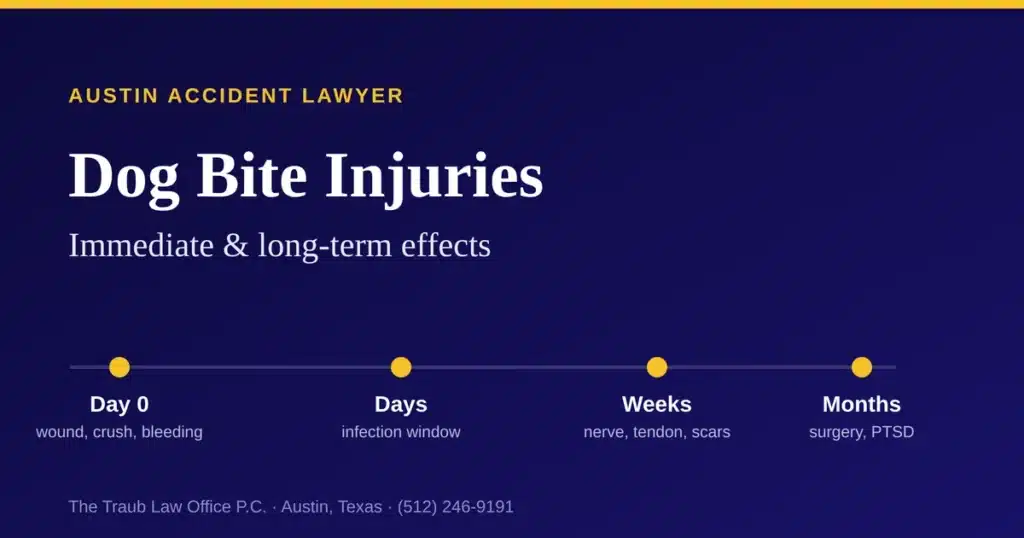
Most dog bites in Austin are minor. Some are life-changing. On the day it happens, the two can look almost the same. And the injuries that end up mattering most are often the ones you can’t see yet: an infection that sets in overnight, a nerve that was cut, a scar that heals badly, a child who won’t sleep for a month.
Here is what dog bite injuries actually involve, in the first hours and over the months that follow, and what to do after a bite here in Austin.
Listen to this article
Read the transcript
This is Dog Bite Injuries: Immediate and Long-Term Effects in Austin, from the Traub Law Office. Updated September 2026.
Most dog bites in Austin are minor. Some are life-changing. The hard part is that on the day it happens, the two can look almost the same. And the injuries that end up mattering most are often the ones you can’t see yet: an infection that sets in overnight, a nerve that was cut, a scar that heals badly, a child who won’t sleep for a month.
Here is what dog bite injuries actually involve, in the first hours and over the months that follow, and what to do after a bite here in Austin.
First, how serious is a dog bite injury? Dog bites send about three hundred thirty-seven thousand people to U.S. emergency rooms every year, and roughly eight hundred thousand bites a year need some kind of medical attention. In pooled international data, about half of bites leave a permanent scar, one in ten needs stitches, and one to five percent require a hospital stay. So the odds are that a given bite is not catastrophic. But not catastrophic still covers a lot of ground: reconstructive surgery, months of wound care, permanent loss of feeling in a hand. The point of getting a bite evaluated promptly is that you usually can’t tell which category you’re in by looking.
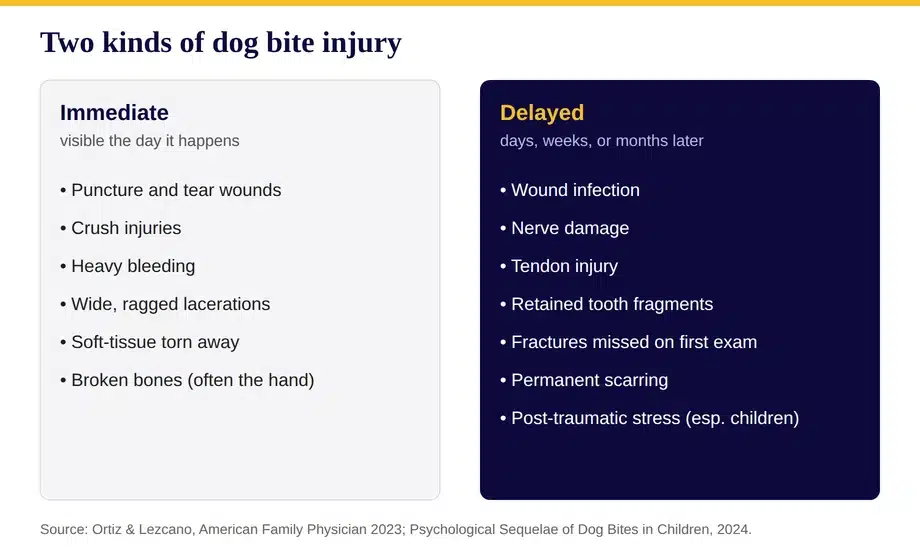
Now, the immediate injuries. A dog’s jaw does two things at once: the teeth puncture and tear, and the jaw crushes. That combination is why dog bites tend to produce crush injuries, wide lacerations, and soft-tissue avulsion, which means skin and tissue torn away or so damaged it dies and has to be removed. On top of that first layer you can have broken bones, especially in the hand, and damage to tendons, blood vessels, and nerves underneath a wound that looks small on the surface. A puncture the size of a pencil eraser can sit directly over a severed tendon.
Next, infection. This is the part people underestimate. Anywhere from two to twenty-five percent of dog bite wounds become infected, and a dog’s mouth carries a mix of bacteria that a household first-aid kit does nothing about. Certain bites carry more risk and usually warrant preventive antibiotics: bites to the hand, foot, face, or genitals, deep puncture wounds, crush injuries, any wound that reaches a joint or bone, and bites in people who are immunosuppressed or have had their spleen removed. In someone without a spleen, one of those bacteria can cause overwhelming, life-threatening sepsis from a wound that looked trivial. Timing matters. The risk of infection climbs once a wound is more than eight to twelve hours old without care, so ”I’ll watch it and see” is the wrong instinct with a bite. You should also be current on tetanus. If your last booster was more than five years ago and the wound is dirty, you need another one.
What about rabies? Rabies from a pet dog in the United States is rare. Canine rabies is controlled here through vaccination programs, and the fewer than ten human rabies deaths the country sees each year are mostly from bats, not dogs. The rule still applies, though. In Austin, a dog that bites someone must be observed for ten full days from the date of the bite, regardless of its vaccination status. If the dog was restrained and current on its rabies shot, the owner may be able to do that observation at home. If the dog was loose or unvaccinated, it has to be confined at a veterinary clinic, and the owner has to provide a current rabies vaccination certificate to Austin Animal Protection. If the dog can’t be found, talk to your doctor about whether post-exposure treatment makes sense.
Then there are the injuries that show up later. Nerve damage: numbness, tingling, or radiating pain after a bite points to a nerve injury. Some recover; some don’t. A bite to the hand that damages a nerve can permanently affect grip, sensation, or fine motor control, which matters enormously if you work with your hands. Tendon injuries can be torn or severed in a bite, and this is easy to miss on a first exam. Dogs break teeth in bites, and fragments can stay in the wound and drive infection later. And with a deep bite from a medium or large dog, or any facial bite that leaves a deformity, imaging is warranted, because associated fractures are not uncommon. This is the practical reason to document everything and follow up: a dog bite injury is often a moving target for the first few weeks.
On scarring and facial injuries: because dog bites tear rather than slice, they tend to heal into wide, irregular scars. Lower-risk wounds, including on the face, can be closed right away. Higher-risk wounds are left to heal from the inside out, which usually means a worse scar. Injuries to the face, scalp, neck, or hands, or any wound likely to scar badly, should be seen by a surgeon for possible repair. Scar revision and reconstructive surgery are real, ongoing costs.
Children are hit harder. They are the most common dog bite patients, and they’re usually bitten by a dog they know, in a home, not by a stray. Because a small child’s head is close to a dog’s mouth, kids are far more likely than adults to be bitten on the head, face, and neck rather than the hands. Children under nine are bitten at a rate of about seventeen and a half per one hundred thousand, and make up roughly two-thirds of the dog bite hospital admissions among minors.
There is also a psychological injury. A dog attack is frightening in a way that outlasts the wound. Post-traumatic stress after a dog bite is well documented in children. In one study of child bite victims, more than half still had symptoms a month or more after the bite, and the children with multiple or deep wounds were the most affected. Younger children and girls tend to show more symptoms; steady support from a parent tends to reduce them. Nightmares, avoiding dogs or the outdoors, jumpiness, and sleep problems are normal reactions in the short term. If they don’t fade, that’s a treatable injury and worth raising with a doctor.
So what should you do after a dog bite in Austin? Get medical care promptly. Same day for anything that breaks the skin, and immediately for a deep wound, a hand or face bite, heavy bleeding, or a bite to a child. Ask the provider to check and note nerve and tendon function, not just close the wound. Report the bite to Austin Animal Protection by filing an Animal Bite Report online or calling three-one-one. This starts the ten-day observation of the dog and creates an official record. Ask your primary care provider about rabies as soon as possible if the dog is unknown, unvaccinated, or can’t be found. Get the dog owner’s information, including their homeowner’s or renter’s insurance. Photograph everything: the wounds as they heal, your torn clothing, and the location. Write down what happened while it’s fresh. Keep every bill and record. And talk to a lawyer before you give a recorded statement to any insurance company.
Finally, when does a dog bite become a legal claim? If someone else’s dog injured you or your child, Texas law may let you recover the cost of that injury from the owner, usually through their homeowner’s or renter’s insurance. Nationwide, insurers paid one point eight six billion dollars on about twenty-eight thousand dog-related injury claims in 2025, and Texas is consistently among the states with the most claims. A few things are worth knowing. You do not need a dog with a bite history. People think a Texas dog gets one free bite. That’s a misreading. You can bring an ordinary negligence claim by showing the owner simply failed to control the dog, and that doesn’t require any prior incident. Fault can be shared: if you’re found more than fifty percent at fault, for provoking the dog, say, you recover nothing, and any fault below that reduces your recovery. And you have two years. The deadline to file a dog bite lawsuit in Texas is generally two years from the date of the bite. A child’s deadline is handled differently, but it is never wise to wait.
If you or your child was bitten by a dog in the Austin area, you can talk it through with Andrew Traub at no cost and no obligation. Call five one two, two four six, nine one nine one, or request a free consultation through our website. There’s no fee unless we recover for you.
This article is general information about dog bite injuries and Texas law, not medical or legal advice. For a bite, see a medical provider. For advice about your situation, speak with a lawyer.
How serious is a dog bite injury?
Dog bites send about 337,000 people to U.S. emergency rooms every year, and roughly 800,000 bites a year need some kind of medical attention. In pooled international data, about half of bites leave a permanent scar, 1 in 10 needs stitches, and 1 to 5 percent require a hospital stay (American Family Physician, 2023).
So the odds are that a given bite is not catastrophic. But “not catastrophic” still covers a lot of ground—reconstructive surgery, months of wound care, permanent loss of feeling in a hand. The point of getting a bite evaluated promptly is that you usually can’t tell which category you’re in by looking.
The immediate injuries
A dog’s jaw does two things at once: the teeth puncture and tear, and the jaw crushes. That combination is why dog bites tend to produce crush injuries, wide lacerations, and soft-tissue avulsion—skin and tissue torn away or so damaged it dies and has to be removed (AAFP, 2023).
On top of that first layer you can have broken bones, especially in the hand, and damage to tendons, blood vessels, and nerves underneath a wound that looks small on the surface. A puncture the size of a pencil eraser can sit directly over a severed tendon.
Infection: the risk that isn’t visible on day one
This is the part people underestimate. Anywhere from 2 to 25 percent of dog bite wounds become infected (StatPearls), and a dog’s mouth carries a mix of bacteria—Pasteurella, Staphylococcus, Streptococcus, Capnocytophaga, and anaerobes—that a household first-aid kit does nothing about (AAFP, 2023).
Some bites carry more risk and usually warrant preventive antibiotics: bites to the hand, foot, face, or genitals; deep puncture and crush wounds; any wound that reaches a joint or bone; and bites in people who are immunosuppressed or have no spleen. In someone without a spleen, one of those bacteria—Capnocytophaga canimorsus—can cause overwhelming, life-threatening sepsis from a wound that looked trivial. The first-line antibiotic for a bite that needs one is amoxicillin-clavulanate (AAFP, 2023).
Timing matters. The risk of infection climbs once a wound is more than 8 to 12 hours old without care, so “I’ll watch it and see” is the wrong instinct with a bite (AAFP, 2023). You should also be current on tetanus—if your last booster was more than five years ago and the wound is dirty, you need another one.
Rabies in Texas: a real rule, a low risk
Rabies from a pet dog in the United States is rare. Canine rabies is controlled here through vaccination programs, and the fewer than 10 human rabies deaths the country sees each year are mostly from bats, not dogs (CDC).
The rule still applies, though. In Austin, a dog that bites someone must be observed for 10 full days from the date of the bite, regardless of its vaccination status. If the dog was restrained and current on its rabies shot, the owner may be able to do that observation at home; if the dog was loose or unvaccinated, it has to be confined at a veterinary clinic. The owner has to provide a current rabies vaccination certificate to Austin Animal Protection (City of Austin Animal Services). If the dog can’t be found, talk to your doctor about whether post-exposure treatment makes sense.
The injuries that show up later
- Nerve damage. Numbness, tingling, or radiating pain after a bite points to a nerve injury. Some recover; some don’t. A bite to the hand that damages a nerve can permanently affect grip, sensation, or fine motor control—which matters enormously if you work with your hands.
- Tendon injuries. Bites can tear or sever tendons, and this is easy to miss on a first exam. Loss of range of motion in a finger or wrist after a bite needs a second look.
- Retained teeth. Dogs break teeth in bites, and fragments can stay in the wound and drive infection later.
- Occult fractures. With a deep bite from a medium or large dog, or any facial bite that leaves a deformity, imaging is warranted because associated fractures are “not uncommon.”
This is the practical reason to document everything and follow up: a dog bite injury is often a moving target for the first few weeks.
Scarring and facial injuries
Because dog bites tear rather than slice, they tend to heal into wide, irregular scars. Wounds at low risk of infection—including on the face, where appearance matters—can be closed right away; higher-risk wounds are left to heal from the inside out, which usually means a worse scar. Injuries to the face, scalp, neck, or hands, or any wound likely to scar badly, should be seen by a surgeon for possible repair (AAFP, 2023).
Scar revision and reconstructive surgery are real, ongoing costs, and facial scarring and disfigurement is one of the injuries we see most often in dog bite cases.
Why children are hit harder
Children are the most common dog bite patients, and they’re usually bitten by a dog they know, in a home, not by a stray (AAFP, 2023).
Because a small child’s head is close to a dog’s mouth, kids are far more likely than adults to be bitten on the head, face, and neck rather than the hands. Children under nine are bitten at a rate of about 17.6 per 100,000 and make up roughly two-thirds of the dog bite hospital admissions among minors (AAFP, 2023).
The psychological injury
A dog attack is frightening in a way that outlasts the wound. Post-traumatic stress after a dog bite is well documented in children: in one study of child bite victims, more than half still had PTSD symptoms a month or more after the bite, and the children with multiple or deep wounds were the most affected. Younger children and girls tend to show more symptoms; steady support from a parent tends to reduce them (Psychological Sequelae of Dog Bites in Children, 2024).
Nightmares, avoiding dogs or the outdoors, jumpiness, and sleep problems are normal reactions in the short term. If they don’t fade, that’s a treatable injury and worth raising with a doctor. In a claim, the emotional and psychological harm counts alongside the physical.
What to do after a dog bite in Austin
- Get medical care promptly—same day for anything that breaks the skin, immediately for a deep wound, a hand or face bite, heavy bleeding, or a bite to a child. Ask the provider to check and note nerve and tendon function, not just close the wound.
- Report the bite to Austin Animal Protection. File an Animal Bite Report online or call 3-1-1 (512-974-2000). This starts the 10-day observation of the dog and creates an official record.
- Ask your primary care provider about rabies as soon as possible if the dog is unknown, unvaccinated, or can’t be found.
- Get the dog owner’s information—name, address, phone, and homeowner’s or renter’s insurance.
- Photograph everything—the wounds before and during healing, your torn clothing, and the location.
- Write down what happened while it’s fresh: where you were, whether the dog was loose or leashed, what the owner said, and the names of any witnesses.
- Keep every bill and record. Follow-up visits, prescriptions, therapy, missed work.
- Talk to a lawyer before you give a recorded statement to any insurance company.
When a dog bite becomes a legal claim
If someone else’s dog injured you or your child, Texas law may let you recover the cost of that injury from the owner—usually through their homeowner’s or renter’s insurance. Nationwide, insurers paid $1.86 billion on about 28,450 dog-related injury claims in 2025 (Insurance Information Institute), and Texas ranked among the three states with the most such claims in the prior year’s report (Triple-I / State Farm, 2025).
- You do not need a dog with a bite history. People think a Texas dog “gets one free bite.” That’s a misreading. Strict liability does require showing the owner knew the dog was dangerous—that comes from Marshall v. Ranne—but you can also bring an ordinary negligence claim by showing the owner simply failed to control the dog, and that doesn’t require any prior incident.
- Fault can be shared. Texas uses a modified comparative fault rule: if you’re found more than 50 percent at fault—for provoking the dog, say—you recover nothing, and any fault below that reduces your recovery (Tex. Civ. Prac. & Rem. Code § 33.001).
- You have two years. The deadline to file a dog bite lawsuit in Texas is generally two years from the date of the bite (Tex. Civ. Prac. & Rem. Code § 16.003). A child’s deadline is handled differently, but it is never wise to wait.
Our Austin dog bite lawyer page goes through how these claims work, what they’re worth, and what we do on them.
Talk to us
If you or your child was bitten by a dog in the Austin area, you can talk it through with Andrew Traub at no cost and no obligation. Call (512) 246-9191 or request a free consultation. There’s no fee unless we recover for you.
This article is general information about dog bite injuries and Texas law, not medical or legal advice. For a bite, see a medical provider. For advice about your situation, speak with a lawyer.
About Andrew Traub
